
Historic Background-Physical Activity in Humans
Physical Activity is a key medicine & lifestyle practice that promote & support good health in humans, and other members of the animal kingdom. Specifically for humans, ever since our feet were placed on this earth, physical activity has been a key component in out survival. In the pre-civilization era (nomadic years), physical activity included:- Hunting prey.
- Running away from predators.
- Building/Constructing weapons & traps for personal protection & the capture of food.
Industrial Revolution. Industrial Evolution. Reduced Physical Activity
The onset of the industrial revolution function as the catalyst of industrial evolution; whereby population(s) economic activity rapidly (relatively) changed from being labour-intensive, to that of being machine-intensive. This transitioning, while it resulted in increased economic productivity, also functioned as a pillar for the onset of lifestyle-based, multinational epidemics, such obesity & type 2 diabetes. This model of industry, economic & physical activity transition, can be seen today in first world countries, such as: USA & England. And third world countries, such as: Jamaica and Trinidad & Tobago.The Challenge of Combatting Physical Inactivity & Reduced Physical Activity (‘Active Couch Potato Phenomenon’) Today
Physical inactivity and reduced physical activity in populations worldwide are dominant challenges to health & productivity at multiple scales. There exist many gyms & exercise/health professionals; as well as digital exercise programs and exercise equipment, accessible to populations worldover (thanks to digital revolution & globalisation); and yet, it seem as if we (advocates for healthier lifestyle practices), are not winning this war.
Poor physical activity & exercise adherence, as well as relapse into physical inactivity or reduced physical activity levels, are perennial challenges we face as members of the global health, fitness & wellness industries. The ‘active couch potato’, is an example of a new physical activity category challenge, we now face. “In healthy individuals, there is evidence, that even if individuals are meeting the physical activity guidelines, the harmfulness of too much sedentary behaviour remains (active couch potato (ACP) phenomenon).” Assessing the ‘Active Couch Potato’ phenomenon in cardiac rehabilitation| Retrieved October 22, 2023
Why is this the case?
What can be done to sustainably combat & reduce the levels of physical inactivity worldwide?
In my view, the more we acknowledge & see the challenge(s) of physical inactivity & reduced physical activity as linked to the overall life (economic, financial, biologic, cultural, geographic) of the individual, group/community & national/regional population, the greater is our chance of sustainably creating solutions, and practices that is relatable & adoptable to the individual, or population in focus.
Intermittent Physical Activity: Cultural Tool to Combat Physical Inactivity & Reduced Physical Activity, Sustainably
Intermittent physical activity is a concept and practice of engaging in a form of movement that can be fit into the schedule, or life, of the individual or population in focus on a daily basis. This is a concept & practice moreso applicable for busy professionals, or economic producers of both formal & informal sectors, as well as seniors. This movement does not have to be rigorous. Nor do you have to commit to 30minutes at a time. As little as 1 minute of movement for every 30 minutes of sitting down, is what can be applied on your part:- Stretching.
- Walking to the restroom.
- Bending to touch your toes, and stretching your arms in the air while sitting, 10 times.
- Standing & sitting in your chair, 10 times

Your Intrinsic & Extrinsic Motivation are Important for Adoption & Sustainable Practice of Intermittent Physical Activity
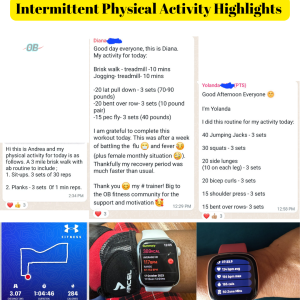
Having the internal motivation to adopt intermittent physical activity is critical for starting and sustaining the practice. If your “why” isn’t known to you, and/or strong, then it will be hard for you to make the behavioural changes befitting for this behavioral adoption. Equally, can be said for extrinsic motivation sources. If you are lacking in access to extrinsic motivation sources, then your initial & long term adoption of intermittent physical activity applicable for your life, can remain as a ghost or theory. Family support, support from co-workers or fellow health/fitness club members, are examples of extrinsic motivation sources. The images above are snippets of professionals showcasing their executed physical activity, done in their own time, with their fellow community members at OB Fitness.
Summary
Physical activity is an important behavior & medicine, that support us attaining & maintaining a state of good health. Yet, the global challenges of physical inactivity & reduced physical activity, remain as significant threats to the health & productivity of the global population today. A solution to combat this threat is intermittent physical activity. For this to be effective however, this practice must be applicable to the individual/group/population in focus, specifc to their culture, geography, economics/finance & temporal (time variables). Both intrinsic & extrinsic sourxes must be identified & present for lasting success.About The Author

Oshane Bryant: BSc Geology, Geography Minor; ACE CPT since 2012; Jamaica Business Development Corporation (JBDC) Accelerator Graduate-2018 cohort; Licensed KUKIBO Martial Arts & Self Defense, Senior Instructor; OB Fitness Founder & Managing Director.