Blood Flow Restriction Bands & Training: Should You Use Them?
Author
admin
Date
June 18, 2022
Share
Filter By Category
Eat More Calories Than You Burn:
Blood Flow Restriction Bands and & Blood Flow Restriction Training is apparently now a popular product & training method in the global fitness industry.
Questions of Interest
When I ‘medz’ (put thought into) this exercise tool/accessory, I see drawbacks. I bring them to your attention in the form of questions, which I intend to address in this article:
What really is supposed to be the beneficial value of blood flow restriction bands, to the user?
How is this beneficial value of blood flow restriction bands, better than your standard (without bands) lactate threshold or anaerobic training-for strength, hypertrophy & anaerobic performance?
Based on the purported science behind blood flow restriction bands effects on the human body, are these bands safe for persons with hypertension, coronary artery disease (CAD), diabetes or any other pathophysiology?
Before I address these questions however, I share some insight into the history & science of blood flow restriction bands.
Brief History & Science of Blood Flow Restriction Bands & Blood Flow Restriction Training
“The BFR technique originated in Japan by Yoshiaki Sato around the year 1960. The process began with self-experimentation, with Sato using the technique to rehabilitate from a fracture on his leg. BFR exercise then gained public notoriety, and made its way into research.”The Evolution of Blood Flow Restricted Exercise; Frontiers in Physiology; December 2021.
Using the excerpt above: the science indicate that this training method act as an alternative mode of exercise, to stimulate muscular hypertrophy (muscle growth). By restricting blood flow to tissues (such as skeletal muscles), this method of exercise is said to:
Induce muscle swelling.
Flood the partially occluded muscles with metabolic by-products that reflect resistance training-without the application of blood flow restricted bands.
Stimulate the recruitment of fast-twitch fibers (through exercise) much faster, relative to resistance exercise executed at similar loads, without the application of the bands.
The Evolution of Blood Flow Restriction Bands & Training
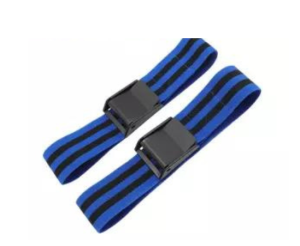
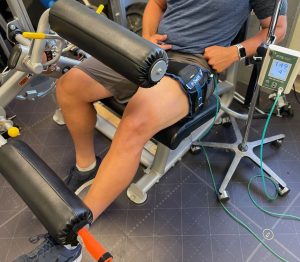
Since it’s usage by Sato for rehabilitation (in its inception), blood flow restriction bands has evolved in design & purpose. They can look like elastic bands (field-such as gyms), or cuffs with sensors to detect pressure levels in limb). Today, blood flow restricted bands can be seen in:
gyms/commercial fitness centers.
clinical labs for exercise science research.
physical therapy/rehab centers.
Field-Based Blood Flow Restriction BandsClinical-Based Blood Flow Restriction Bands. Source: https://lermagazine.com/cover_story/recent-advances-in-the-application-of-blood-flow-restriction-for-health-and-performance
While as a training method blood flow restriction was proven effective towards yielding rehabilitation in its inception. The evolution of blood flow restriction as a training method, and in band design, highlight inconclusiveness in it’s safety (through application). “The inability to use traditional BFR in applied settings, like gyms and practice facilities, has stimulated the development of more practical approaches to traditional BFR exercise. Practical BFR exercise consists of using elastic bands or wraps placed around the exercising limbs and not connected to any external pressure controlling device. These techniques are much more affordable and widely available for sale online and require little to no training but have the potential to be over-tightened by those not familiar with the theory of BFR exercise.”The Evolution of Blood Flow Restricted Exercise; Frontiers in Physiology; December 2021.
What Should Be The Beneficial Value Of Blood Flow Restriction Bands & Training To The User?
To yield muscular strength adaptation & minimize muscle wasting with very little stress on non-muscular tissue(s) such as tendons & bones. This benefit suits persons rehabilitating from sports-related injuries or surgeries such as:
Cruciate Ligament tear/reconstruction.
Bone Fracture.
Achilles Tendon rupture/reconstruction.
Blood flow restriction bands & training, also suits persons non-desirous of high intensity exercise, but still want to have his/her body experience muscular hypertrophy gains.
Resistance Training With Blood Flow Restriction Bands vs Resistance Training With No Bands: Which Is Better?
In my opinion, resistance training with no bands is better.
If you are a patient in a clinical setting with access to blood flow restriction bands, this serves as a great tool and training method for rehabilitation & muscular atrophy mitigation, yes-especially if you’re unable to move your limb(s) on your own. However, passive exercise intervention (aided by a clinical exercise professional such as a physical therapist) works just as well. Potentially even better.
Why?
Because through passive exercise, muscles worked through a wider range of motion (relative to blood flow restriction training) can be strengthened; as well as the tendons, ligaments and other tissues.
Should you consider training in non-clinical setting, my view(s) remain unchanged. Resistance training with blood flow restriction bands limit you to training at relatively low strength intensity levels (such as 20-50% 1rpm). Not only that, the current recommendation is for exercise bouts with bands to be either intermittent (conduct exercise with band, and take off at rest); or continuous for maximum 30minutes. On the basis of specificity, resistance training for both strength & size, is best achieved with loads at approximately 65-100% 1rpm. On this basis, even if you elicit fast twitch fiber recruitment through blood flow restriction training (at 20-50% 1rpm), those fast twitch fibers cannot be called on adequately, in movements they’re not accustomed to through specific training not involving blood flow restriction bands, such as in powerlifting.
Also, given that field-based blood flow restriction bands currently don’t have the electronic sensors to depict the tissue pressure, consistency through applied pressure, is hard to achieve-especially by persons new to blood flow restriction bands, and training (for both exercise professional & non-professionals alike).
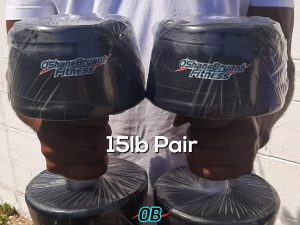
Order Your Pair Of Dumbbells (5lb-50lb). Available In Concrete & Metal. click on Image to learn more & order.
Should Persons In Non-Clinical Setting With Medical Conditions Such As Hypertension & Diabetes Use Blood Flow Restriction Bands?
Given that field-based blood flow restriction bands don’t offer sensors that can be more accurate in depicting target tissue pressure through occlusion (currently). And given that research is inconclusive on field-based blood flow restriction bands being safe for the general population (through standards in application, intensity scale and others), let alone population segments with non-communicable diseases such as hypertension & diabetes, my answer is no.
I am of the view that persons with medical conditions such as as hypertension & diabetes, should not use blood flow restriction bands, outside of the clinical setting.
“Your Sustainable Fitness Partner”
About The Author
Oshane Bryant: BSc Geology, Geography Minor; ACE CPT since 2012; Jamaica Business Development Corporation (JBDC) Accelerator Graduate-2018 cohort; KUKIBO Martial Arts & Self Defense, Senior Instructor; OB Fitness Founder & Managing Director.



 Oshane Bryant: BSc Geology, Geography Minor; ACE CPT since 2012; Jamaica Business Development Corporation (JBDC) Accelerator Graduate-2018 cohort; KUKIBO Martial Arts & Self Defense, Senior Instructor; OB Fitness Founder & Managing Director.